Competition Clutch H-Series 184mm Twin Disc Ceramic Clutch
- Handles up to 1350 horsepower.
- Smooth engagement with micro finished material.
- Power-V drive system for longevity.
- Direct bolt-in fit for Honda H Series.
- Precision CNC machined for durability.
- Description
- Vehicle Fitment
- Technical Data
- Install Guide
-
Competition Clutch H-Series 184mm Twin Disc Ceramic Clutch Kit (1992-2002 Prelude, Accord & CL)
This is Competition Clutch's 184mm (7.25") twin disc ceramic clutch kit for Honda H-series and F-series engines. It fits 1992-2001 Preludes (H22A, H22A1, H22A4, H23A1), 1990-2002 Accords (F22A, F22B, F23A), and 1997-1999 Acura CL (4-cylinder models only). The kit includes a 4140 forged steel flywheel, two ceramic friction discs with a self-centering floater plate, a 6061 T6 aluminum cover, and a 6150 steel diaphragm. Previously sold as part number 4-8014-C.
Competition Clutch rates the 184 series twin disc at up to 1,350 hp. On H/F-series applications, retailers and builders typically cite 500 to 1,200 whp depending on torque output and launch style. That's the realistic range. For most turbo H22 and F-series builds, this clutch won't be the weak link in your drivetrain.
Why This Matters More on H-Series Than B-Series
H-series and F-series engines make significantly more torque per horsepower than B-series motors. A turbo H22 at 500 whp produces more torque than a turbo B18C at 500 whp because of the larger displacement (2.2L vs. 1.8L). Clutches care about torque, not horsepower. A clutch rated for "600 hp on a B16" might slip on an H22 making 500 whp because the H22's torque output is substantially higher at the same power level.
This is why twin discs make sense at lower horsepower numbers on H-series builds compared to B-series. If you're building a turbo H22 Prelude or turbo F-series Accord, you'll reach the limits of a single-disc clutch sooner than you would on a B-series motor at the same whp number. The twin disc's ability to spread torque across four friction surfaces (two discs, two sides each) gives you a much larger safety margin on these higher-torque applications.
Why a Twin Disc Instead of a Single
A single-disc clutch has one friction surface clamped between the pressure plate and flywheel. To hold more power with a single disc, you need more clamping force (heavier pedal) and more aggressive friction material (harsher engagement). On H-series builds, that escalates fast because of the torque output. A Stage 4 or Stage 5 puck single disc rated for an H22 turbo build requires a pressure plate so stiff your left leg will hate you in traffic.
A twin disc splits the work across two discs and a floater plate. Four friction surfaces instead of two. That means the pressure plate doesn't need to clamp as hard to hold the same torque, which translates to lighter pedal effort. Less shock per engagement, less heat per launch, and less stress on your synchros and axles every time you shift. On a Prelude H22 turbo car that still sees street duty, that's the real value of the twin disc: it holds big power without punishing you or your transmission to do it.
Single Disc (Stage 4/5 Puck) Twin Disc (This Kit) Friction Surfaces 2 (one disc, two sides) 4 (two discs, two sides each, plus floater plate) Pedal Effort Heavy (high-clamp PP needed) Lighter than a comparably-rated single (load shared) Engagement Feel Harsh, on/off (especially puck) Still aggressive but more progressive Drivetrain Shock High (all force through one disc) Reduced (distributed across two discs) Heat Management One disc absorbs all heat Heat split across two discs and floater plate Rotational Mass Varies by disc size 184mm discs are smaller and lighter than stock 225mm Realistic Holding (H/F-Series) 200-400+ whp depending on stage 500-1,200 whp Why 184mm Discs Instead of Stock Size
Stock H-series clutch discs are approximately 225mm (8.9"). This kit uses 184mm (7.25") discs. Smaller discs are lighter, which means less rotational inertia. The engine revs faster between shifts and the synchros have less mass to synchronize during gear changes. On an H22 revving to 8,000+ RPM with cams and a built head, quicker rev matching between gears adds up over a drag pass or a time attack session.
The trade-off is that smaller discs have less friction surface per disc. The twin disc design compensates: two 184mm discs with a floater plate provide more total friction area than a single stock-size disc. You get the rev speed benefit of lighter, smaller discs and the holding power of increased total surface area.
What's in the Kit
This kit includes the flywheel. You don't reuse your OEM flywheel. Everything you need is in the box:
-
4140 Forged Steel Flywheel
Dedicated to the 184mm twin disc assembly. The flywheel is the only component that differs between the H-series kit (1848014-2) and the B-series kit (1848026-2). The pressure plate, discs, floater plate, and cover are the same between both kits. If you're doing an H2B swap (H-series engine, B-series transmission), you need a different part number entirely: 4-80142-C.
-
Two Ceramic Friction Discs (184mm / 7.25")
Unsprung, 6-puck ceramic. The ceramic material handles extreme heat cycles better than organic or Kevlar compounds. Each disc is smaller and lighter than a single stock-size disc. 24-spline, 1-1/32" input shaft.
-
Self-Centering Floater Plate (Power-V Drive System)
Sits between the two friction discs. Competition Clutch's Power-V design lets the floater plate self-center as it wears, distributing clamping force evenly across both discs. This means both discs wear at roughly the same rate.
-
6061 T6 Aluminum Cover with 6150 Steel Diaphragm
CNC machined. The aluminum cover keeps weight down while the steel diaphragm provides clamping force.
-
Throwout Bearing, Pilot Bearing, Alignment Tool
All included. Push-type release. Replace both bearings every time.
What It's Actually Like to Drive
The H-series and Prelude community has run the CC twin disc for years in turbo Preludes, turbo Accords, and drag builds. Here's the real feedback, not the marketing version:
Pedal effort is stiffer than stock, but not leg-day territory. Most owners describe it as roughly 2-3x stock pedal weight. That's noticeable. But compared to a single-disc Stage 4 or Stage 5 with a high-clamp pressure plate (which is what you'd need for the same power level on a single disc), it's actually lighter. One Honda-Tech H22 turbo owner reported switching from a high-clamp single to the CC twin and finding the pedal effort more manageable.
Engagement is grabby but not a light switch. There's a narrow engagement zone. You'll stall it a few times the first day. Within a week, most owners have it dialed. It's more aggressive than stock but less violent than an unsprung single 6-puck. Forum consensus: "once you figure out the grab point, it's fine."
Floater plate rattle. When you push the clutch pedal in, the floater plate between the two discs rattles. Every twin disc clutch does this. It sounds like something's loose. It's not. It's most noticeable sitting at a light with the clutch pedal down. Some call it a "soft jingle," others call it annoying. It doesn't go away and it's not a defect.
Ceramic engagement noise. The ceramic pads chirp or squeak during engagement, every time. In a turbo Prelude with a downpipe and an exhaust, you won't notice. In a quiet car at low speed, you will. This is the nature of ceramic friction material.
Can you daily it? The H22/Prelude community is split the same way everyone else is on twin discs. One Honda-Tech user daily drove the CC twin on a turbo H22 making 382 whp/260 wtq and called it "a bit on the annoying side" but functional. Another on PreludeOnline said they'd never go back to a single disc. If your commute is mostly highway with a few lights, it's livable. If you're crawling in stop-and-go for an hour, the heavier pedal and narrow engagement point will wear on you. It's more streetable than a single-disc puck at the same power level, but it's still a race-oriented clutch.
When a Twin Disc Makes Sense on an H/F-Series Build
Your Build Recommendation NA H22 or F-series, stock or bolt-ons (under 220 whp) Stock replacement or Stage 2. A $1,400 twin disc on a stock H22 Prelude is a waste of money. Mild turbo H22 (220-350 whp), daily driven Stage 3 full-face or Stage 4 sprung single disc. Holds the power, easier to live with daily. Moderate turbo (350-500 whp), street/strip This is where the twin disc starts making real sense on H-series. Remember, H22 torque at 400 whp is substantially higher than B18 torque at 400 whp. A single disc Stage 4 is working hard at this level. The twin disc holds the same power with less pedal effort and less shock loading on your Prelude transmission. Big turbo (500-1,000+ whp), drag or track The twin disc sweet spot for H-series. Single discs are at or past their limits. This is what this clutch was built for. 1,000+ whp all-out build Consider the 184mm triple disc (1848014-3) for sustained abuse at this power level. Vehicle Fitment
This kit fits Honda H-series and F-series engines using the factory H/F-series transmission with push-type clutch actuation. The "8014" in the original part number (4-8014-C) designates the H/F-series transmission family.
Chassis Vehicle Years Engines Trims BB1/BB4 Honda Prelude 1992-1996 (4th gen) H23A1, H22A1 S, Si, Si 4WS, VTEC, SE BB6/BB8 Honda Prelude 1997-2001 (5th gen) H22A4 Base, Type SH CB7 Honda Accord 1990-1993 (4th gen) F22A1, F22A4, F22A6 Manual trans models only CD5/CD7 Honda Accord 1994-1997 (5th gen) F22B1, F22B2 Manual trans models only CG Honda Accord 1998-2002 (6th gen) F23A1, F23A4, F23A5 Manual trans, 4-cylinder only UA Acura CL 1997-1999 (1st gen) F22B1, F23A1 4-cylinder manual models only Accord buyers: This fits 4-cylinder manual transmission Accords ONLY. If your Accord has a V6 (J-series), this clutch doesn't fit. The V6 Accords use a completely different transmission and clutch assembly.
CL buyers: The 1997-1999 CL came in 4-cylinder (F22B1/F23A1) and V6 (J30A1) versions. This clutch ONLY fits the 4-cylinder CL with manual transmission.
H2B swaps: If you're running an H22 engine with a B-series transmission (H2B conversion), this kit does NOT fit. You need the H2B-specific twin disc, part number 4-80142-C. The H2B kit uses a different flywheel machined for the B-series transmission bellhousing. The pressure plate, discs, and cover are the same between the two kits. The flywheel is the only difference.
Hybrid Racing SKU: COC-1848014-2
Manufacturer Part Number: 1848014-2 (formerly 4-8014-C)
Series: 184mm Full Race Twin Disc Ceramic
Disc Size: 184mm (7.25")
Disc Spline: 24-spline, 1-1/32" input shaft
Disc Type: Unsprung ceramic, 6-puck, two discs with floater plate
Flywheel: 4140 forged steel (INCLUDED)
Cover: 6061 T6 aluminum
Diaphragm: 6150 steel
Release Type: Push
Power Rating: Up to 1,350 hp (CC marketing); 500-1,200 whp (application-dependent)
Made in: Anaheim, California
Kit Weight: 21.9 lbsThis Kit Does NOT Fit
Several fitment tags on this product page are wrong. Here's what doesn't work and why:
- 1988-1991 Honda Prelude (3rd gen): The 3rd gen Prelude uses B20A and B21A engines. Completely different engine family, different bellhousing, different clutch assembly. This kit is for H-series and F-series engines only.
- 2003-2007 Honda Accord (7th gen): The 7th gen Accord switched to K24A4/K24A8 engines with K-series transmissions. Completely different clutch. If you need a twin disc for a K24 Accord, you need a K-series clutch kit.
- 2008-2012 Honda Accord (8th gen): K24Z engine, K-series transmission. Not compatible.
- 2013-2017 Honda Accord (9th gen): K24W engine or CVT. Not compatible.
- 2018-2022 Honda Accord (10th gen): L15B7 turbo or K20C4 engine. Completely different platform. Not compatible.
- 2023-2024 Honda Accord (11th gen): L15T engine. No manual transmission is even offered. This tag makes no sense.
- 2001-2003 Acura CL (2nd gen): The 2nd gen CL is V6 only (J32A1/J32A2). Different engine, different transmission, different clutch. Not compatible.
- Any H2B swap (H22 engine with B-series transmission): The flywheel in this kit is machined for the H/F-series bellhousing. If you've converted to a B-series transmission, you need part number 4-80142-C, which uses the same discs and cover but with a B-series specific flywheel.
Installation Notes
- The flywheel is included. Do not reuse your OEM flywheel. The 184mm discs won't fit a stock H-series flywheel. The included 4140 forged steel flywheel is machined specifically for the 184mm assembly.
- Use new flywheel bolts. ARP flywheel bolts are cheap insurance on a build making this kind of power. Apply the correct torque spec.
- Replace both bearings. The throwout bearing and pilot bearing are included in the kit. Install them. The throwout bearing in particular sees more stress with a twin disc setup.
- Check the rear main seal before you install. Oil on ceramic friction surfaces causes slipping and uneven wear. If the rear main is seeping at all, replace it now. Pulling the transmission twice because of a $15 seal is not a fun experience.
- Inspect your Prelude transmission carefully. H-series transmissions (M2S4, M2A4, M2B4, M2U4, etc.) aren't known for being bulletproof at high power levels. If you're stepping up to a twin disc because you're making 400+ whp, the gears and synchros are now the next weak link. Many turbo Prelude builders pair this clutch with a built or reinforced transmission. Budget accordingly.
- Bleed the hydraulic system completely. Fresh fluid, full bleed, no air in the line. Air makes the already-narrow engagement point even harder to find.
- Break-in: 500 miles gentle driving. No hard launches, no aggressive shifts, no boosting. The ceramic pads need to bed into both disc surfaces and the floater plate. Engagement will feel inconsistent during break-in. It smooths out after the pads seat.
- Prelude Type SH note: The Type SH has Honda's ATTS (Active Torque Transfer System) on the front differential. This system adds complexity to the drivetrain. The twin disc clutch itself installs the same on SH and non-SH models, but if you're making big turbo power, verify that your ATTS unit can handle the torque. Many Prelude turbo builders delete or bypass ATTS above certain power levels.
184mm Series Lineup: Single, Twin, and Triple
Competition Clutch offers the 184mm series for H/F-series in three configurations. All share the same 7.25" disc diameter, ceramic friction material, and included flywheel. The difference is the number of discs and the power capacity.
184mm Single (1848014-1) 184mm Twin (1848014-2) - This Kit 184mm Triple (1848014-3) Discs 1 2 + floater plate 3 + 2 floater plates Power Rating Up to 700 hp Up to 1,350 hp Beyond 1,350 hp Best For (H-Series) Moderate turbo, 300-500 whp track builds Big turbo drag, time attack, 500+ whp All-out race, Pro class Weight/Complexity Lightest, simplest Moderate Heaviest, most components Common Questions
Does this include a flywheel?
Yes. A 4140 forged steel flywheel is included and required. You can't use your OEM H-series flywheel because the 184mm disc assembly needs a specific flywheel machined for the smaller disc diameter.What's the old part number?
4-8014-C. Competition Clutch previously offered A, B, and C power ratings. They've consolidated to one spec (all are now the "C" rating). The 1848014-2 is the current part number.What's the difference between this kit (1848014-2) and the B-series kit (1848026-2)?
The flywheel. That's it. The pressure plate assembly, discs, floater plate, and cover are identical between the H-series and B-series twin disc kits. The flywheel is machined for the respective engine's crankshaft bolt pattern and bellhousing interface.I'm doing an H2B swap. Can I use this kit?
No. The H2B swap puts an H-series engine on a B-series transmission. The flywheel in this kit is machined for the H-series bellhousing. You need the H2B-specific kit, part number 4-80142-C, which has the correct flywheel for a B-series bellhousing.My turbo H22 makes 380 whp. Is the twin disc overkill?
A Honda-Tech user with a turbo H22 making 382 whp/260 wtq on pump gas ran the CC twin and described it as "completely overkill" for that power level. At 380 whp, a Stage 3 or Stage 4 single disc will hold your power with less cost and better daily drivability. The twin disc really earns its keep starting around 450-500+ whp on H-series applications, where single discs are being pushed to their limits and the higher pedal effort of a heavy single starts becoming genuinely uncomfortable.Do I need to upgrade my H-series transmission for this power level?
If you're shopping for a twin disc because you're making 500+ whp on a turbo H22, yes, you should be thinking about the transmission. Factory H-series gearboxes have known limits. The clutch will hold the power, but the gears, synchros, and differential behind it may not. Many turbo Prelude builders run rebuilt or reinforced H-series transmissions, or convert to stronger gearboxes. The twin disc reduces the shock loading that kills transmissions, which helps, but it can't make a stock gearbox hold 800 whp.Does this fit my V6 Accord or V6 CL?
No. V6 models (J-series engines) use a completely different transmission and clutch assembly. This kit is for 4-cylinder (H-series and F-series) models with manual transmission only.How does the CC twin disc compare to the Action Clutch twin disc for H-series?
Action Clutch offers a 7.25" twin disc for the H22/H23 as well. The CC twin disc has a longer track record in the Honda community and the self-centering Power-V floater plate, which helps with even disc wear. Action Clutch uses sintered metallic discs rather than ceramic. Both are competent units. The CC twin is more established in the turbo Prelude scene specifically.Who Should Buy This (And Who Shouldn't)
Buy this if: Your turbo H22, turbo H23, or turbo F-series build makes 450+ whp and you need a clutch that holds the power without destroying your left leg or shock-loading your already-stressed H-series transmission. You're building a dedicated drag car or time attack Prelude and want the lightest rotating assembly with the most holding capacity. You've already burned through a Stage 4 or Stage 5 single disc and need to step up.
Don't buy this if: Your H22 Prelude or F-series Accord is naturally aspirated or mildly boosted under 350 whp. A Stage 2 or Stage 3 single disc holds that power, drives better, costs less, and doesn't rattle. Spending $1,400 on a twin disc for a bolt-on Prelude is serious overkill.
Consider the 184mm single disc (1848014-1) instead if: You're in the 300-700 whp range and want the smaller 184mm disc diameter for reduced rotational mass, but don't need the twin disc's holding capacity. Same flywheel, same concept, one disc instead of two. Rated to 700 hp, lighter, simpler, less expensive.
-
4140 Forged Steel Flywheel
-
This kit fits Honda H-series and F-series engines using the factory H/F-series transmission with push-type clutch actuation. The "8014" in the original part number (4-8014-C) designates the H/F-series transmission family.
Chassis Vehicle Years Engines Trims BB1/BB4 Honda Prelude 1992-1996 (4th gen) H23A1, H22A1 S, Si, Si 4WS, VTEC, SE BB6/BB8 Honda Prelude 1997-2001 (5th gen) H22A4 Base, Type SH CB7 Honda Accord 1990-1993 (4th gen) F22A1, F22A4, F22A6 Manual trans models only CD5/CD7 Honda Accord 1994-1997 (5th gen) F22B1, F22B2 Manual trans models only CG Honda Accord 1998-2002 (6th gen) F23A1, F23A4, F23A5 Manual trans, 4-cylinder only UA Acura CL 1997-1999 (1st gen) F22B1, F23A1 4-cylinder manual models only Accord buyers: This fits 4-cylinder manual transmission Accords ONLY. If your Accord has a V6 (J-series), this clutch doesn't fit. The V6 Accords use a completely different transmission and clutch assembly.
CL buyers: The 1997-1999 CL came in 4-cylinder (F22B1/F23A1) and V6 (J30A1) versions. This clutch ONLY fits the 4-cylinder CL with manual transmission.
H2B swaps: If you're running an H22 engine with a B-series transmission (H2B conversion), this kit does NOT fit. You need the H2B-specific twin disc, part number 4-80142-C. The H2B kit uses a different flywheel machined for the B-series transmission bellhousing. The pressure plate, discs, and cover are the same between the two kits. The flywheel is the only difference.
Original: $1,399.00
-65%$1,399.00
$489.65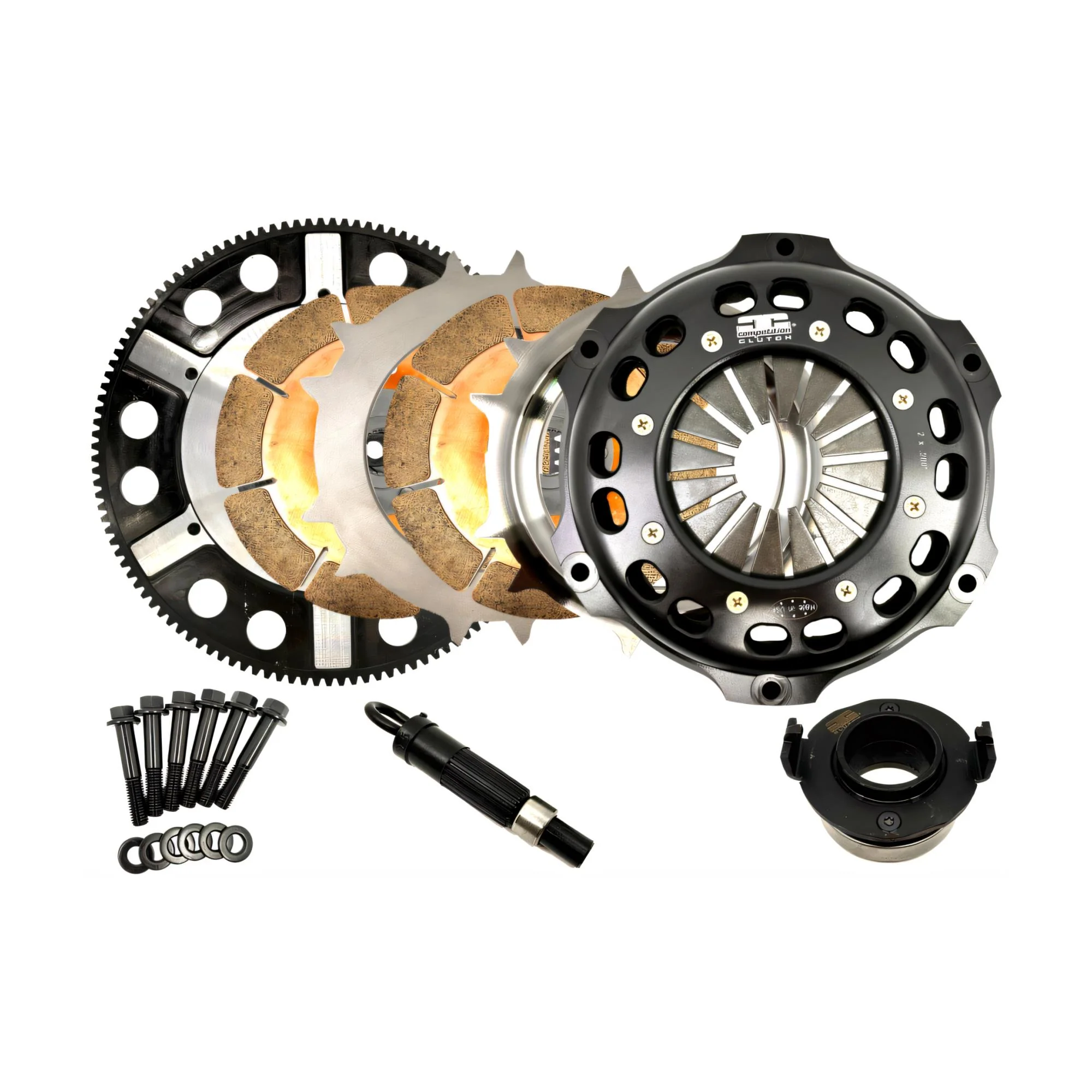
Description
- Handles up to 1350 horsepower.
- Smooth engagement with micro finished material.
- Power-V drive system for longevity.
- Direct bolt-in fit for Honda H Series.
- Precision CNC machined for durability.
- Description
- Vehicle Fitment
- Technical Data
- Install Guide
-
Competition Clutch H-Series 184mm Twin Disc Ceramic Clutch Kit (1992-2002 Prelude, Accord & CL)
This is Competition Clutch's 184mm (7.25") twin disc ceramic clutch kit for Honda H-series and F-series engines. It fits 1992-2001 Preludes (H22A, H22A1, H22A4, H23A1), 1990-2002 Accords (F22A, F22B, F23A), and 1997-1999 Acura CL (4-cylinder models only). The kit includes a 4140 forged steel flywheel, two ceramic friction discs with a self-centering floater plate, a 6061 T6 aluminum cover, and a 6150 steel diaphragm. Previously sold as part number 4-8014-C.
Competition Clutch rates the 184 series twin disc at up to 1,350 hp. On H/F-series applications, retailers and builders typically cite 500 to 1,200 whp depending on torque output and launch style. That's the realistic range. For most turbo H22 and F-series builds, this clutch won't be the weak link in your drivetrain.
Why This Matters More on H-Series Than B-Series
H-series and F-series engines make significantly more torque per horsepower than B-series motors. A turbo H22 at 500 whp produces more torque than a turbo B18C at 500 whp because of the larger displacement (2.2L vs. 1.8L). Clutches care about torque, not horsepower. A clutch rated for "600 hp on a B16" might slip on an H22 making 500 whp because the H22's torque output is substantially higher at the same power level.
This is why twin discs make sense at lower horsepower numbers on H-series builds compared to B-series. If you're building a turbo H22 Prelude or turbo F-series Accord, you'll reach the limits of a single-disc clutch sooner than you would on a B-series motor at the same whp number. The twin disc's ability to spread torque across four friction surfaces (two discs, two sides each) gives you a much larger safety margin on these higher-torque applications.
Why a Twin Disc Instead of a Single
A single-disc clutch has one friction surface clamped between the pressure plate and flywheel. To hold more power with a single disc, you need more clamping force (heavier pedal) and more aggressive friction material (harsher engagement). On H-series builds, that escalates fast because of the torque output. A Stage 4 or Stage 5 puck single disc rated for an H22 turbo build requires a pressure plate so stiff your left leg will hate you in traffic.
A twin disc splits the work across two discs and a floater plate. Four friction surfaces instead of two. That means the pressure plate doesn't need to clamp as hard to hold the same torque, which translates to lighter pedal effort. Less shock per engagement, less heat per launch, and less stress on your synchros and axles every time you shift. On a Prelude H22 turbo car that still sees street duty, that's the real value of the twin disc: it holds big power without punishing you or your transmission to do it.
Single Disc (Stage 4/5 Puck) Twin Disc (This Kit) Friction Surfaces 2 (one disc, two sides) 4 (two discs, two sides each, plus floater plate) Pedal Effort Heavy (high-clamp PP needed) Lighter than a comparably-rated single (load shared) Engagement Feel Harsh, on/off (especially puck) Still aggressive but more progressive Drivetrain Shock High (all force through one disc) Reduced (distributed across two discs) Heat Management One disc absorbs all heat Heat split across two discs and floater plate Rotational Mass Varies by disc size 184mm discs are smaller and lighter than stock 225mm Realistic Holding (H/F-Series) 200-400+ whp depending on stage 500-1,200 whp Why 184mm Discs Instead of Stock Size
Stock H-series clutch discs are approximately 225mm (8.9"). This kit uses 184mm (7.25") discs. Smaller discs are lighter, which means less rotational inertia. The engine revs faster between shifts and the synchros have less mass to synchronize during gear changes. On an H22 revving to 8,000+ RPM with cams and a built head, quicker rev matching between gears adds up over a drag pass or a time attack session.
The trade-off is that smaller discs have less friction surface per disc. The twin disc design compensates: two 184mm discs with a floater plate provide more total friction area than a single stock-size disc. You get the rev speed benefit of lighter, smaller discs and the holding power of increased total surface area.
What's in the Kit
This kit includes the flywheel. You don't reuse your OEM flywheel. Everything you need is in the box:
-
4140 Forged Steel Flywheel
Dedicated to the 184mm twin disc assembly. The flywheel is the only component that differs between the H-series kit (1848014-2) and the B-series kit (1848026-2). The pressure plate, discs, floater plate, and cover are the same between both kits. If you're doing an H2B swap (H-series engine, B-series transmission), you need a different part number entirely: 4-80142-C.
-
Two Ceramic Friction Discs (184mm / 7.25")
Unsprung, 6-puck ceramic. The ceramic material handles extreme heat cycles better than organic or Kevlar compounds. Each disc is smaller and lighter than a single stock-size disc. 24-spline, 1-1/32" input shaft.
-
Self-Centering Floater Plate (Power-V Drive System)
Sits between the two friction discs. Competition Clutch's Power-V design lets the floater plate self-center as it wears, distributing clamping force evenly across both discs. This means both discs wear at roughly the same rate.
-
6061 T6 Aluminum Cover with 6150 Steel Diaphragm
CNC machined. The aluminum cover keeps weight down while the steel diaphragm provides clamping force.
-
Throwout Bearing, Pilot Bearing, Alignment Tool
All included. Push-type release. Replace both bearings every time.
What It's Actually Like to Drive
The H-series and Prelude community has run the CC twin disc for years in turbo Preludes, turbo Accords, and drag builds. Here's the real feedback, not the marketing version:
Pedal effort is stiffer than stock, but not leg-day territory. Most owners describe it as roughly 2-3x stock pedal weight. That's noticeable. But compared to a single-disc Stage 4 or Stage 5 with a high-clamp pressure plate (which is what you'd need for the same power level on a single disc), it's actually lighter. One Honda-Tech H22 turbo owner reported switching from a high-clamp single to the CC twin and finding the pedal effort more manageable.
Engagement is grabby but not a light switch. There's a narrow engagement zone. You'll stall it a few times the first day. Within a week, most owners have it dialed. It's more aggressive than stock but less violent than an unsprung single 6-puck. Forum consensus: "once you figure out the grab point, it's fine."
Floater plate rattle. When you push the clutch pedal in, the floater plate between the two discs rattles. Every twin disc clutch does this. It sounds like something's loose. It's not. It's most noticeable sitting at a light with the clutch pedal down. Some call it a "soft jingle," others call it annoying. It doesn't go away and it's not a defect.
Ceramic engagement noise. The ceramic pads chirp or squeak during engagement, every time. In a turbo Prelude with a downpipe and an exhaust, you won't notice. In a quiet car at low speed, you will. This is the nature of ceramic friction material.
Can you daily it? The H22/Prelude community is split the same way everyone else is on twin discs. One Honda-Tech user daily drove the CC twin on a turbo H22 making 382 whp/260 wtq and called it "a bit on the annoying side" but functional. Another on PreludeOnline said they'd never go back to a single disc. If your commute is mostly highway with a few lights, it's livable. If you're crawling in stop-and-go for an hour, the heavier pedal and narrow engagement point will wear on you. It's more streetable than a single-disc puck at the same power level, but it's still a race-oriented clutch.
When a Twin Disc Makes Sense on an H/F-Series Build
Your Build Recommendation NA H22 or F-series, stock or bolt-ons (under 220 whp) Stock replacement or Stage 2. A $1,400 twin disc on a stock H22 Prelude is a waste of money. Mild turbo H22 (220-350 whp), daily driven Stage 3 full-face or Stage 4 sprung single disc. Holds the power, easier to live with daily. Moderate turbo (350-500 whp), street/strip This is where the twin disc starts making real sense on H-series. Remember, H22 torque at 400 whp is substantially higher than B18 torque at 400 whp. A single disc Stage 4 is working hard at this level. The twin disc holds the same power with less pedal effort and less shock loading on your Prelude transmission. Big turbo (500-1,000+ whp), drag or track The twin disc sweet spot for H-series. Single discs are at or past their limits. This is what this clutch was built for. 1,000+ whp all-out build Consider the 184mm triple disc (1848014-3) for sustained abuse at this power level. Vehicle Fitment
This kit fits Honda H-series and F-series engines using the factory H/F-series transmission with push-type clutch actuation. The "8014" in the original part number (4-8014-C) designates the H/F-series transmission family.
Chassis Vehicle Years Engines Trims BB1/BB4 Honda Prelude 1992-1996 (4th gen) H23A1, H22A1 S, Si, Si 4WS, VTEC, SE BB6/BB8 Honda Prelude 1997-2001 (5th gen) H22A4 Base, Type SH CB7 Honda Accord 1990-1993 (4th gen) F22A1, F22A4, F22A6 Manual trans models only CD5/CD7 Honda Accord 1994-1997 (5th gen) F22B1, F22B2 Manual trans models only CG Honda Accord 1998-2002 (6th gen) F23A1, F23A4, F23A5 Manual trans, 4-cylinder only UA Acura CL 1997-1999 (1st gen) F22B1, F23A1 4-cylinder manual models only Accord buyers: This fits 4-cylinder manual transmission Accords ONLY. If your Accord has a V6 (J-series), this clutch doesn't fit. The V6 Accords use a completely different transmission and clutch assembly.
CL buyers: The 1997-1999 CL came in 4-cylinder (F22B1/F23A1) and V6 (J30A1) versions. This clutch ONLY fits the 4-cylinder CL with manual transmission.
H2B swaps: If you're running an H22 engine with a B-series transmission (H2B conversion), this kit does NOT fit. You need the H2B-specific twin disc, part number 4-80142-C. The H2B kit uses a different flywheel machined for the B-series transmission bellhousing. The pressure plate, discs, and cover are the same between the two kits. The flywheel is the only difference.
Hybrid Racing SKU: COC-1848014-2
Manufacturer Part Number: 1848014-2 (formerly 4-8014-C)
Series: 184mm Full Race Twin Disc Ceramic
Disc Size: 184mm (7.25")
Disc Spline: 24-spline, 1-1/32" input shaft
Disc Type: Unsprung ceramic, 6-puck, two discs with floater plate
Flywheel: 4140 forged steel (INCLUDED)
Cover: 6061 T6 aluminum
Diaphragm: 6150 steel
Release Type: Push
Power Rating: Up to 1,350 hp (CC marketing); 500-1,200 whp (application-dependent)
Made in: Anaheim, California
Kit Weight: 21.9 lbsThis Kit Does NOT Fit
Several fitment tags on this product page are wrong. Here's what doesn't work and why:
- 1988-1991 Honda Prelude (3rd gen): The 3rd gen Prelude uses B20A and B21A engines. Completely different engine family, different bellhousing, different clutch assembly. This kit is for H-series and F-series engines only.
- 2003-2007 Honda Accord (7th gen): The 7th gen Accord switched to K24A4/K24A8 engines with K-series transmissions. Completely different clutch. If you need a twin disc for a K24 Accord, you need a K-series clutch kit.
- 2008-2012 Honda Accord (8th gen): K24Z engine, K-series transmission. Not compatible.
- 2013-2017 Honda Accord (9th gen): K24W engine or CVT. Not compatible.
- 2018-2022 Honda Accord (10th gen): L15B7 turbo or K20C4 engine. Completely different platform. Not compatible.
- 2023-2024 Honda Accord (11th gen): L15T engine. No manual transmission is even offered. This tag makes no sense.
- 2001-2003 Acura CL (2nd gen): The 2nd gen CL is V6 only (J32A1/J32A2). Different engine, different transmission, different clutch. Not compatible.
- Any H2B swap (H22 engine with B-series transmission): The flywheel in this kit is machined for the H/F-series bellhousing. If you've converted to a B-series transmission, you need part number 4-80142-C, which uses the same discs and cover but with a B-series specific flywheel.
Installation Notes
- The flywheel is included. Do not reuse your OEM flywheel. The 184mm discs won't fit a stock H-series flywheel. The included 4140 forged steel flywheel is machined specifically for the 184mm assembly.
- Use new flywheel bolts. ARP flywheel bolts are cheap insurance on a build making this kind of power. Apply the correct torque spec.
- Replace both bearings. The throwout bearing and pilot bearing are included in the kit. Install them. The throwout bearing in particular sees more stress with a twin disc setup.
- Check the rear main seal before you install. Oil on ceramic friction surfaces causes slipping and uneven wear. If the rear main is seeping at all, replace it now. Pulling the transmission twice because of a $15 seal is not a fun experience.
- Inspect your Prelude transmission carefully. H-series transmissions (M2S4, M2A4, M2B4, M2U4, etc.) aren't known for being bulletproof at high power levels. If you're stepping up to a twin disc because you're making 400+ whp, the gears and synchros are now the next weak link. Many turbo Prelude builders pair this clutch with a built or reinforced transmission. Budget accordingly.
- Bleed the hydraulic system completely. Fresh fluid, full bleed, no air in the line. Air makes the already-narrow engagement point even harder to find.
- Break-in: 500 miles gentle driving. No hard launches, no aggressive shifts, no boosting. The ceramic pads need to bed into both disc surfaces and the floater plate. Engagement will feel inconsistent during break-in. It smooths out after the pads seat.
- Prelude Type SH note: The Type SH has Honda's ATTS (Active Torque Transfer System) on the front differential. This system adds complexity to the drivetrain. The twin disc clutch itself installs the same on SH and non-SH models, but if you're making big turbo power, verify that your ATTS unit can handle the torque. Many Prelude turbo builders delete or bypass ATTS above certain power levels.
184mm Series Lineup: Single, Twin, and Triple
Competition Clutch offers the 184mm series for H/F-series in three configurations. All share the same 7.25" disc diameter, ceramic friction material, and included flywheel. The difference is the number of discs and the power capacity.
184mm Single (1848014-1) 184mm Twin (1848014-2) - This Kit 184mm Triple (1848014-3) Discs 1 2 + floater plate 3 + 2 floater plates Power Rating Up to 700 hp Up to 1,350 hp Beyond 1,350 hp Best For (H-Series) Moderate turbo, 300-500 whp track builds Big turbo drag, time attack, 500+ whp All-out race, Pro class Weight/Complexity Lightest, simplest Moderate Heaviest, most components Common Questions
Does this include a flywheel?
Yes. A 4140 forged steel flywheel is included and required. You can't use your OEM H-series flywheel because the 184mm disc assembly needs a specific flywheel machined for the smaller disc diameter.What's the old part number?
4-8014-C. Competition Clutch previously offered A, B, and C power ratings. They've consolidated to one spec (all are now the "C" rating). The 1848014-2 is the current part number.What's the difference between this kit (1848014-2) and the B-series kit (1848026-2)?
The flywheel. That's it. The pressure plate assembly, discs, floater plate, and cover are identical between the H-series and B-series twin disc kits. The flywheel is machined for the respective engine's crankshaft bolt pattern and bellhousing interface.I'm doing an H2B swap. Can I use this kit?
No. The H2B swap puts an H-series engine on a B-series transmission. The flywheel in this kit is machined for the H-series bellhousing. You need the H2B-specific kit, part number 4-80142-C, which has the correct flywheel for a B-series bellhousing.My turbo H22 makes 380 whp. Is the twin disc overkill?
A Honda-Tech user with a turbo H22 making 382 whp/260 wtq on pump gas ran the CC twin and described it as "completely overkill" for that power level. At 380 whp, a Stage 3 or Stage 4 single disc will hold your power with less cost and better daily drivability. The twin disc really earns its keep starting around 450-500+ whp on H-series applications, where single discs are being pushed to their limits and the higher pedal effort of a heavy single starts becoming genuinely uncomfortable.Do I need to upgrade my H-series transmission for this power level?
If you're shopping for a twin disc because you're making 500+ whp on a turbo H22, yes, you should be thinking about the transmission. Factory H-series gearboxes have known limits. The clutch will hold the power, but the gears, synchros, and differential behind it may not. Many turbo Prelude builders run rebuilt or reinforced H-series transmissions, or convert to stronger gearboxes. The twin disc reduces the shock loading that kills transmissions, which helps, but it can't make a stock gearbox hold 800 whp.Does this fit my V6 Accord or V6 CL?
No. V6 models (J-series engines) use a completely different transmission and clutch assembly. This kit is for 4-cylinder (H-series and F-series) models with manual transmission only.How does the CC twin disc compare to the Action Clutch twin disc for H-series?
Action Clutch offers a 7.25" twin disc for the H22/H23 as well. The CC twin disc has a longer track record in the Honda community and the self-centering Power-V floater plate, which helps with even disc wear. Action Clutch uses sintered metallic discs rather than ceramic. Both are competent units. The CC twin is more established in the turbo Prelude scene specifically.Who Should Buy This (And Who Shouldn't)
Buy this if: Your turbo H22, turbo H23, or turbo F-series build makes 450+ whp and you need a clutch that holds the power without destroying your left leg or shock-loading your already-stressed H-series transmission. You're building a dedicated drag car or time attack Prelude and want the lightest rotating assembly with the most holding capacity. You've already burned through a Stage 4 or Stage 5 single disc and need to step up.
Don't buy this if: Your H22 Prelude or F-series Accord is naturally aspirated or mildly boosted under 350 whp. A Stage 2 or Stage 3 single disc holds that power, drives better, costs less, and doesn't rattle. Spending $1,400 on a twin disc for a bolt-on Prelude is serious overkill.
Consider the 184mm single disc (1848014-1) instead if: You're in the 300-700 whp range and want the smaller 184mm disc diameter for reduced rotational mass, but don't need the twin disc's holding capacity. Same flywheel, same concept, one disc instead of two. Rated to 700 hp, lighter, simpler, less expensive.
-
4140 Forged Steel Flywheel
-
This kit fits Honda H-series and F-series engines using the factory H/F-series transmission with push-type clutch actuation. The "8014" in the original part number (4-8014-C) designates the H/F-series transmission family.
Chassis Vehicle Years Engines Trims BB1/BB4 Honda Prelude 1992-1996 (4th gen) H23A1, H22A1 S, Si, Si 4WS, VTEC, SE BB6/BB8 Honda Prelude 1997-2001 (5th gen) H22A4 Base, Type SH CB7 Honda Accord 1990-1993 (4th gen) F22A1, F22A4, F22A6 Manual trans models only CD5/CD7 Honda Accord 1994-1997 (5th gen) F22B1, F22B2 Manual trans models only CG Honda Accord 1998-2002 (6th gen) F23A1, F23A4, F23A5 Manual trans, 4-cylinder only UA Acura CL 1997-1999 (1st gen) F22B1, F23A1 4-cylinder manual models only Accord buyers: This fits 4-cylinder manual transmission Accords ONLY. If your Accord has a V6 (J-series), this clutch doesn't fit. The V6 Accords use a completely different transmission and clutch assembly.
CL buyers: The 1997-1999 CL came in 4-cylinder (F22B1/F23A1) and V6 (J30A1) versions. This clutch ONLY fits the 4-cylinder CL with manual transmission.
H2B swaps: If you're running an H22 engine with a B-series transmission (H2B conversion), this kit does NOT fit. You need the H2B-specific twin disc, part number 4-80142-C. The H2B kit uses a different flywheel machined for the B-series transmission bellhousing. The pressure plate, discs, and cover are the same between the two kits. The flywheel is the only difference.